
Intervista a Tobia Scarpa
Interview with Tobia Scarpa
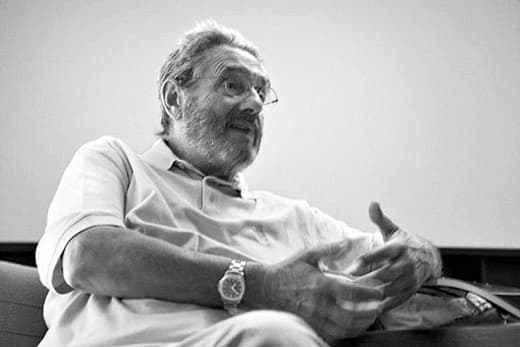
Attraverso la campagna trevigiana in direzione di Mogliano Veneto per raggiungere lo studio domestico di Tobia Scarpa: un edificio che un tempo aveva un’aria rurale, circondato dal verde estivo particolarmente rigoglioso, che l’attuale proprietario ha restaurato e ampliato con una sua particolare eleganza. Attraverso un piccolo cortile, su cui si affacciano sia l’ingresso della casa sia l’edificio che ospita lo studio, entro in un mondo diverso rispetto alla campagna che lo circonda.
La conversazione avviene in uno spazio molto intimo all’interno dell’edificio originale, un piccolo salotto dove, sebbene in modo discreto, i segni della trasformazione sono chiaramente leggibili: dalla pavimentazione alla valorizzazione della sporgenza nel muro che ospita il camino.
Iniziamo la conversazione parlando di Dino Gavina, l’artefice dell’incontro tra Tobia Scarpa e Pier Giacomo Castiglioni.
Gavina è stato un personaggio molto interessante nella cultura artistica italiana, in particolare nella cultura del design. Era un imprenditore, ma aveva più il carattere di un promotore di idee che di un direttore d’azienda. Non era abbastanza egoista da pretendere sempre e costantemente la redditività degli oggetti, e si lasciava trasportare dalle idee che lo entusiasmavano. E così gli oggetti, anche se straordinariamente promettenti, faticavano a generare profitti, tanto che dovette vendere la sua attività ad altri più di una volta.
Con Flos, le cose andarono più o meno così, anche se in realtà la vicenda è molto più complessa e sfaccettata.
Come tante cose, Flos nacque un po’ per caso: Biliotti (all’epoca rappresentante della Eisenkeil di Merano, e in seguito dirigente della futura Flos, ndr) era andato da Gavina per presentargli i suoi prodotti, tra cui quelli realizzati con la resina cocoon. Gavina, che era innamorato di due figure, ovvero i fratelli Castiglioni – in particolare Pier Giacomo – e Carlo Scarpa, lo indirizzò proprio ai Castiglioni e a mio padre, affinché potessero valutare ciò che stava proponendo.
Mio padre era impegnato in altri progetti, quindi suggerì che iniziassi io, e colsi al volo l’occasione.
Il primo progetto dei Castiglioni con questo materiale – per noi nuovo – che veniva chiamato ‘cocoon’, fu una serie di lampade costruite su una struttura metallica diversa da quella precedentemente usata da Noguchi. I Castiglioni disegnarono tre pezzi con questo materiale: una lampada da comodino, Gatto, poi Viscontea e infine Taraxacum.
Poi arrivai io, e disegnai un prodotto che sfruttava appieno il potenziale della resina cocoon: Fantasmi, che si basava su un principio diverso rispetto alle lampade progettate da Noguchi e dai Castiglioni.
A me interessava – e mi interessa tuttora – che emergesse la personalità di questo materiale, legata alla mia immaginazione. Una volta spruzzata, la resina cocoon si ritira durante l’asciugatura, e la forma che ne risulta dipende da ciò che si inserisce all’interno del tessuto. All’interno di Fantasmi posizionai due fili da pesca che si curvavano in base alla tensione del materiale.
Gavina portò i nostri nuovi prodotti nel suo negozio in San Babila, a Milano, quasi di fronte a dove oggi si trovano gli uffici della Flos. Successivamente, alcuni bresciani si unirono come soci. A guidarli c’era Gandini, che aveva un negozio di mobili a Brescia. I Castiglioni erano preoccupati per il cambiamento e non volevano continuare come designer per Flos, e ricordo che fui io a convincerli a restare.
Gandini trasferì l’azienda da Merano a Brescia, e fu proprio in quel momento che nacque davvero Flos come azienda ben gestita anche dal punto di vista imprenditoriale.
I soci dell’epoca erano Cassina, Eisenkeil, Gandini e Gavina. Poi, a un certo punto, ci fu una nuova riorganizzazione e Gavina, Simoncini, Eisenkeil e Biliotti uscirono di scena.
Biliotti andò a lavorare da Venini, a Murano, e a sua volta lanciò VeArt. Tutte persone che hanno fatto cose importanti per il design.
Visto che eri in stretto contatto lavorativo con i fratelli Castiglioni, non hai mai pensato di realizzare un progetto insieme a loro?
Sentivamo di dover rispondere a poetiche diverse. Eravamo in due mondi distinti, due culture differenti. A Venezia abbiamo la nebbia che modifica la luce e rende tutto molto più morbido. A Milano, invece, c’è il rombo dei motori.
Quindi io e i fratelli Castiglioni vivevamo situazioni molto diverse. La Milano degli anni ’60 e ’70 era vista – e si proponeva – come il centro del mondo del design, mentre io sono convinto che il design sia il risultato di un’avventura condivisa, più che di un luogo particolare.
Io vivevo a Venezia e non partecipavo alla vita milanese, per cui i nostri rapporti erano legati alle occasioni che di volta in volta si presentavano.
Infatti, Livio Castiglioni, dal mio punto di vista, comparve sulla scena solo più tardi, quando ero già un designer affermato. Ci incontravamo alla Triennale o alla Biennale.
Invece vedevo sempre gli altri due fratelli Castiglioni lavorare in coppia: uno iniziava una frase e l’altro la finiva. Quando li incontrai, era esattamente così: Popo iniziava e Achille completava la frase.
Qual è l’oggetto di Pier Giacomo, o dei fratelli Castiglioni, a cui sei più legato?
Direi che, più che a un oggetto specifico, mi incuriosisce il loro modo di cogliere una verità negli oggetti che non è affatto scontata: il sellino della bicicletta montato su un emisfero di ferro che produceva una sorta di effetto autobilanciante, dato il peso molto ridotto rispetto alla natura piuttosto precaria della seduta; oppure un sedile in ferro da trattore con un pezzo di metallo stampato come supporto, ed ecco che avevano fatto una sedia.
Per me è importante quello spirito un po’ dadaista che sa cogliere lo straordinario nelle cose: la loro capacità di percepire qualcosa che normalmente non vediamo, perché siamo troppo abituati a considerare l’oggetto in base all’uso che ne facciamo.
Il nuovo sistema, la nuova proposta che i Castiglioni offrivano, era un atto di sospensione, su cui riflettere per trovare una verità più profonda. A mio avviso, questo si avvicina molto alla poesia.
La poesia è la capacità, l’intuizione, di cogliere – attraverso il linguaggio del materiale utilizzato, che sia pittura, poesia o design – la combinazione magica delle cose.
Non c’è poesia se non c’è vibrazione tra due elementi posti l’uno accanto all’altro: l’atto poetico è proprio quello capace di far vibrare il potenziale degli oggetti tra loro.
Nel contesto della poesia scritta, cioè delle parole, una parola porta in sé significati infiniti, e solo alcuni di essi possono essere evocati dal poeta per suscitare emozione nel lettore.
L’emozione emerge dagli elementi più nascosti e profondi del nostro essere.
I Castiglioni sono nati e cresciuti in un ambiente di grande tradizione. Sono figli di un artista, dal quale hanno assorbito gli elementi fondamentali del sentire, della sensibilità e della sottigliezza di giudizio.
Quindi, ciò che apprezzi di più nel lavoro dei Castiglioni è la loro capacità di suscitare emozione?
Sicuramente la loro capacità, da questo punto di vista, era magica, anche se al tempo stesso era in parte ridotta dal fatto che prendevano anche in considerazione l’effetto che avrebbero ottenuto. Ma di certo quello era l’approccio giusto, e forse è proprio questo in cui Gavina credeva di più.
Quale oggetto di Pier Giacomo, o dei fratelli Castiglioni, ti piacerebbe rigenerare?
Ognuno di quegli oggetti ha la sua storia, quindi penso che sia impossibile cambiarli, e men che meno migliorarli. Non riesco a immaginare perché qualcuno come me dovrebbe volerli migliorare.
Se fossi uno dei Castiglioni, sarei molto infastidito se qualcuno cercasse di migliorare un mio oggetto nel modo in cui abbiamo visto fare da altri.
Penso anche che l’idea di proseguire un percorso già intrapreso da qualcun altro sia piuttosto improbabile, perché la poetica è una questione individuale, anche se nel loro caso si esprimeva in coppia.
Nel momento in cui queste due persone hanno compiuto un cammino, non credo sia corretto dire che si possa continuare: arriva un momento in cui la poesia si conclude – lunga o breve, bella o brutta, non importa.
C’è un punto in cui quella poesia finisce.
Può diventare un punto di riferimento per altri, ma non può essere modificata.
Tenendo presente il tema della rigenerazione, come vedi questo tema nel tuo lavoro di architetto?
Rigenerare significa riportare in vita, ridare vitalità, restituire movimento, ecc. Nella mia vita professionale ho avuto l’opportunità di rigenerare alcune cose che avevo fatto, ma non nel campo del design, perché l’oggetto di design ha chiaramente una vita diversa e anche un valore intrinseco differente: una sedia ha il valore di una sedia, per quanto lussuosa sia, e quindi, una volta concluso il ciclo del suo utilizzo previsto, si passa oltre.
L’architettura è un’altra cosa. Se costruisco una fabbrica, l’edificio resta anche dopo venti o trent’anni. Con Benetton, ho fatto parte del team che ha realizzato il loro primo stabilimento e, quando l’azienda è cresciuta e quell’edificio è diventato troppo piccolo per ospitare la produzione, è stato logico destinarlo ad altro uso.
Rigenerando alcune parti e completando elementi che all’epoca erano stati tralasciati perché troppo costosi, è stato semplice trasformare la vecchia struttura in uffici.
Come dicevo, con gli oggetti di design è più difficile, anche se mi piacerebbe riprendere la lampada Perpetua che avevo disegnato per Flos e rifarla utilizzando una tecnologia diversa, che aumenti significativamente il tempo tra una ricarica e l’altra, che allora era di tre o quattro ore. Mi sembra giusto offrire questa possibilità.
All’epoca Perpetua non ebbe molto successo perché mancava la tecnologia. Oggi, con i LED, potrebbe restare accesa per tre o quattro giorni.
Riconoscere l’inadeguatezza della tecnologia è anche in parte ciò che ha portato alla nascita della lampada Toio. I Castiglioni volevano una lampada con un’alta potenza luminosa, ma non potevano usare le lampadine disponibili in commercio. Così presero quello che c’era e lo adattarono all’uso domestico: un faro d’auto.
Lasciando il trasformatore a vista e utilizzando parti di una canna da pesca, crearono un tipo di lampada completamente nuovo, con un risultato divertente e di grande impatto visivo.
Che consiglio daresti ai giovani che iniziano nel campo della progettazione di oggetti o spazi?
Se guardiamo alla cultura in cui hanno vissuto i Castiglioni o mio padre, quella del dopoguerra immediato, è evidente che oggi ci troviamo di fronte a una realtà completamente diversa.
All’epoca avevamo l’accademia, che era ancora molto figlia del rigore settecentesco, derivato dalla filosofia dei Lumi, e che forniva agli studenti una conoscenza approfondita delle tecniche del passato.
Gli studenti dovevano andare a vedere come si costruiva un capitello, come si realizzava una colonna, perché proprio quella colonna, quale fosse il simbolismo, ecc.
Così, in genere, gli studenti delle accademie avevano una comprensione solida e sistematica delle relazioni. Oggi non è più così.
Il presente è una cacofonia di problemi, di stimoli, di illusioni, accentuata dalla televisione e da internet. Tutti questi elementi che scandiscono la nostra quotidianità comportano un tale spreco di tempo ed energia che le persone non riescono più a formarsi.
Per fare un mestiere che ruota attorno all’atto poetico, alla sottigliezza necessaria per la poesia, servono basi solide, e questa è una cosa che la società di oggi fatica a offrire.
Se un giovane vuole essere un architetto della poesia e non solo della costruzione, è essenziale che impari a essere attento e, quando identifica un problema, sia in grado di considerarlo dal giusto punto di vista, offrendo soluzioni che sappiano generare gioia.
Nonostante abbia circa ottant’anni, cerco di aumentare la mia sensibilità verso le cose.
Mi accorgo che mi meraviglio ancora di fronte al nuovo, perché ho ancora voglia di meravigliarmi!
Quando si guarda un dipinto, quando si guarda per vedere davvero, quando si cerca di riconoscere un grande artista, si cercano i dettagli, si osservano le parti più delicate, le più nascoste, l’interazione tra i colori, la finitura delle superfici. Gli artisti mediocri non raggiungono certe raffinatezze sublimi, o perché non ne sono capaci o perché non le hanno comprese o non le hanno ritenute necessarie.
È lo spirito che ricerca la finezza a spingerci sempre a migliorare. E i giovani devono lottare per imparare a guardare per vedere.
Tobia Scarpa è nato a Venezia l’11 gennaio 1935 e ha iniziato la sua carriera professionale insieme ad Afra Bianchin nel 1957 realizzando le sue prime opere presso le vetrerie Venini di Murano.
Nel 1960 ha iniziato a collaborare con Dino Gavina e Luciano Benetton, per i quali ha progettato la prima fabbrica, la casa e la catena di negozi, curando l’immagine dell’azienda.
Quando si è laureato in architettura a Venezia nel 1969, aveva già una carriera affermata.
Oltre a Benetton, ha progettato l’allestimento dei negozi per importanti aziende italiane, tra cui C&B, Geox e Unifor, oltre agli uffici di alcune realtà collegate.
Vincitore del premio Compasso d’Oro per la poltrona Soriana (1970), ha disegnato numerosi prodotti di successo, tra cui il divano Bastiano (1961) e il letto Vanessa (1962) per Gavina, la lampada Fantasma (1962) e la lampada Biagio (1968) per Flos, e la poltrona Modell 917 (1963) e la sedia Soriana (1969) per Cassina.
Dal 2001 al 2010 ha insegnato alla Facoltà di Disegno Industriale di Venezia.
Nel 2008 ha ricevuto il Compasso d’Oro alla carriera.
Tobia Scarpa
I travel through the Treviso countryside toward Mogliano Veneto to reach the home studio of Tobia Scarpa: a building that one had a rural air, surrounded by the particularly lush summer greenery, which the current owner has restored and expanded with his own particular elegance. I cross a small farmyard overlooked by both the entrance to the house and the building that houses the studio and enter a world different from the countryside that surrounds it.
The conversation takes place in a very intimate space inside the original building, a small living room where, although discreet, the signs of transformation are clearly legible: from the flooring to the highlighting of the bulge in the wall that houses the fireplace.
Let's start the conversation by talking about Dino Gavina, who was the architect of the meeting between Tobia Scarpa and Pier Giacomo Castiglioni.
Gavina was a very interesting character in Italian art culture, particularly in design culture. He was an entrepreneur but had the character of an ideas promoter rather than a company director. He was not selfish enough to always and constantly demand profitability from the objects, and he let himself get carried away by ideas that excited him. And so the objects, even if extraordinarily promising, struggled to make a profit, and so he had to sell his business to others more than once.
With Flos, things went a little like this, although the reality is actually much more complex and multifaceted.
Like so many things, Flos was born somewhat by chance: Biliotti, (representative at the time of Eisenkeil in Merano, and later manager of the future Flos, Ed.), had come to Gavina to pitch his products including those made with cocoon resin. Gavina, who was enamoured of two people, namely the Castiglionis, in particular Pier Giacomo, and Carlo Scarpa, directed him to the Castiglionis and to my father so that they could evaluate what he was proposing. My father was busy with other things, so he suggested I make a start, and I jumped at the chance. The first Castiglioni design using this material, which was new to us and was referred to as ‘cocoon’, were lamps built on a different metal structure from the one previously used by Noguchi. The Castiglionis designed three pieces with this material: a bedside lamp, Gatto, then Viscontea and then Taraxacum. Then I came and designed a product that used the potential of cocoon resin: Fantasmi, which used a different principle from the lamps designed by Noguchi and the Castiglionis. I was interested, and remain interested, in the emergence of the personality of this material linked to my imagination. After being sprayed, cocoon resin shrinks as it dries, and the shape that emerges depends on what you put inside the fabric. Inside Fantasmi, I placed two fishing lines that curved according to the tension of the material.
Gavina took our new products to his shop in San Babila, Milan, almost directly opposite where the Flos headquarters are today. Later, some Brescians joined as partners. They were headed by Gandini, who had a furniture shop in Brescia. The Castiglionis were worried about the change and did not want to stay on as designers with Flos, and I remember being the one who persuaded them otherwise.
Gandini brought the company from Merano to Brescia, and that moment really gave rise to Flos as a properly managed company from a business point of view. The partners at the time were Cassina, Eisenkeil, Gandini and Gavina. Then at some point there was a further reorganization and Gavina, Simoncini, Eisenkeil and Biliotti all left. Bilotti went to work at Venini in Murano and in turn launched VeArt. All people who did good things for design.
Since you were in close contact with the Castiglioni brothers in terms of work, did you never think of taking on a project together?
We felt we had to respond to different poetics. We were in two different worlds, two different cultures. In Venice we have the mist that modifies the light and makes everything much softer. In Milan, you have the roar of engines. So the Castiglioni brothers and I lived in very different situations. The Milan of the 1960s and 1970s was seen as and positioned itself as the centre of the world of design, while I am convinced that design is the result of a common adventure rather than a particular place. I lived in Venice and did not participate in Milanese life, so our interactions were linked to the occasions we had from time to time. In fact, Livio Castiglioni only appeared on the scene from my perspective some time later, when I was a well-established designer. We met in the Triennale or at the Biennale.
Instead, I saw the two other Castiglioni brothers always working as a pair: one started a sentence and the other finished it. When I met them, it was exactly like that: Popo started and Achille finished the sentence.
How did it work at Flos? Did the client suggest the design, or did the designer?
The reason the Castiglionis had considered leaving Flos at the time of the restructuring was a lack of clarity regarding their roles. I proposed a formula that was accepted and lasted for a long time, which consisted essentially in allowing the Castiglionis and me the right to review the company's product policy, in other words to grant us the shared role of art director. So we were able to make the products that we thought were right, right for us and right for the company, in complete freedom without the marketing man interfering, which would have unavoidably degraded our freedom of expression, as he would be too conditioned by the market. An object was proposed by us autonomously, then accepted or not, but as regards the initial process of creating it, we were entirely free to define that ourselves. And Flos made substantial profits, as Cesare Cassina always pointed out.
One way of explaining how we worked at Flos that comes to mind is to take the example of the Parentesi lamp (Achille Castiglioni, Flos, 1971, Ed.) which was born out of a strange combination of events: the son of the sculptor Manzù was involved in Flos but unfortunately died in an accident, leaving behind the idea of a lamp that could be moved vertically along a tube. Achille Castiglioni became passionate about the idea of the flexible wire passing through the tube. He bent the tube containing the wire to create friction that would hold the lamp at different heights. Magical!
Which object by Pier Giacomo, by the Castiglioni brothers, are you most attached to?
I would say that more than a specific object I am intrigued by their way of grasping a truth in objects that is not so obvious: the bicycle seat mounted on an iron hemisphere providing a kind of self-balancing effect given the very low weight compared to the rather precarious seat; an iron tractor seat with a piece of moulded metal as a support, and they had made a chair.
It's important to me, that kind of Dada spirit that can grasp the extraordinary nature of things: their ability to grasp something that we don't usually see because we are too used to seeing the object according to the way it is used. The new system, the new proposal that the Castiglionis were offering, was an act of suspension on which to reflect and find a greater truth. In my opinion, this falls very close to poetry. Poetry is the ability, the intuition, to grasp, through the language of the material being used, whether it be painting, poetry or design, the magical combination of things.
There is no poetry if there is no vibration between two elements that are placed close to each other, so the poetic act is precisely the one capable of vibrating the potential of objects between them. In the context of written poetry, that is, words, a word has in itself infinite meanings, and only some of them can be summoned by the poet to stir emotion in the reader. Emotion emerges from the most hidden and deepest elements of our being. The Castiglionis were born and raised in an environment of great tradition. They are the children of an artist, from whom they have drawn the basic elements of feeling, sensitivity and subtlety of judgement.
So, what you appreciate most in the work of the Castiglionis is its ability to inspire emotion?
Certainly their ability was magical in this regard, even if it was diminished at the same time, as they were also considering the effect they would achieve, but surely that was the right approach and perhaps that is what Gavina believed in most.
Which object by Pier Giacomo, by the Castiglioni brothers, who would like to regenerate?
Every one of those objects has its own history, so I think it's impossible to change them, let alone improve them. I can’t imagine why someone like me would want to improve them. If I were one of the Castiglionis, I would be very unhappy if someone improved my object in the way we have seen others do.
I also think that the idea of continuing a path that’s already been started by someone else is rather unlikely, because poetics are an individual matter, even if in their case, they expressed it as a pair. At the moment, when these two people have made a journey, I don’t think it’s correct to say that you can continue it: there comes a moment when you end the poem, long or short, good or bad, it doesn’t matter. There is a point at which that poem comes to an end. It can become a reference point for others, but it cannot be changed.
Bearing in mind the theme of regeneration, how do you see this theme in your work as an architect?
Re-generation means reviving life, reviving vitality, restoring movement, etc. In my professional life, I’ve had the opportunity to regenerate things I've done, but not in design, because the design product clearly has a different life and also a different intrinsic value: a chair has the value of a chair, however luxurious it is, and so once the cycle of its intended use is over, you move on.
Architecture is a different matter. If I build a factory, the factory building remains even after twenty or thirty years. With Benetton, I was part of a team working to build their first factory, and when the company grew and that building became too small to house production, it was logical to use it for something else.
By regenerating parts and completing elements that were left undone at the time because they were too expensive, it was a breeze to turn the old structure into office space.
As I said, with design objects it is more difficult, although I would like to take the Perpetua lamp that I designed for Flos and remake it using a different technology that significantly increases the length of time between charges, which was three or four hours back then. It seems right to offer this possibility. Back then, Perpetua didn’t do very well because the technology was lacking. Today, with LEDs, it could stay on for three or four days.
Recognizing the inadequacy of the technology is also partly what led to the Toio lamp. The Castiglionis wanted high output for their lamp, but couldn’t use the bulbs that were commercially available. So they took what was available and adapted it to domestic use: a car headlight. By leaving the transformer in view and using parts from a fishing rod, they created a wholly new kind of lamp, with a fun and visually impactful result.
What advice would you have for young people starting out in the field of designing objects or spaces?
If we look back to the culture that the Castiglionis or my father lived in, that of the immediate post-war period, it is clear that we are facing a different reality now.
Back then, we had the academy, which was still very much a product of 18th-century rigour, derived from the philosophy of the Lumières, and endowed students with in-depth knowledge of techniques used in the past. Students had to go and see how a capital was built, how a column was made, why that particular column, what the symbolism was etc. And so students of the academies generally had a firm and systematic understanding of the relationships. This is no longer the case. The present day is a cacophony of problems, of enticements, of illusions, accentuated by television and the internet. All these elements that punctuate our daily lives involve such a waste of time and energy that people no longer have the capacity to educate themselves.
To do a job that revolves around the poetic act, the subtlety necessary for poetry, we need solid foundations, and that is something that today’s society is struggling to offer. If a young person wants to be an architect of poetry and not of building, it is essential that they learn to be attentive and, when they identify a problem, are able to consider it from the right point of view, offering solutions that spark joy.
Despite being about 80 years old, I try to increase my own sensitivity to things. I see that I be amazed by new things because I still want to be amazed!
When you look at a painting, when you look to see, when you look to recognize a great artist, you look for details, you look at it in the most delicate parts, in the most hidden parts, in the exchange between colours, in the finish of the surfaces. Mediocre artists do not reach certain sublime refinements, either because they are not capable of them or because they have not understood or believed them to be necessary. It is the spirit that seeks finesse that always drives us to improve. And young people have to struggle to learn how to look to see.
Tobia Scarpa was born in Venice on January 11, 1935 and began his professional career together with Afra Bianchin in 1957 by realizing his first works at the Venini glass factories in Murano. In 1960 he began collaborating with Dino Gavina and Luciano Benetton, for whom he designed the first factory, the house and the chain of shops curating the image of the company. By the time he graduated in architecture in Venice 1969, he already had an established career. In addition to Benetton, he designed the shop fit-outs for well-known Italian companies, including C&B, Geox and Unifor, as well as the offices of some related establishments.
Winner of the Compasso d'Oro award for the Soriana armchair (1970), he has designed numerous successful products including the Bastiano sofa (1961) and the Vanessa bed (1962) for Gavina, the Fantasma lamp (1962) and Biagio lamp (1968) for Flos; and the Modell 917 armchair (1963) and the Soriana chair (1969) for Cassina.
From 2001 to 2010, he taught at the Faculty of Industrial Design in Venice.
In 2008 he received the Compasso d’Oro award for his career.
Tobia Scarpa
↑ Testimonianza tratta dal libro "Pier Giacomo 100 volte Castiglioni".